Trip: 25 January to 17 February 2016
by Jacky Duruisseau
(photos: Colette Bridon, Chantal and Jean-Louis Béreau, and Jacky Duruisseau)
When we thought about going to track down begonias in Colombia, the reaction of our friends (and family) was unanimous: Colombia? You must be mad… with the FARC, the drug cartels (and Zika)! Aren’t you afraid? So we advised them to start saving… for the ransom…
In reality, when we showed our itinerary (built from the GPS points we had) to our guide Xavier (a French-Ecuadorian we had already “worked” with twice in Ecuador), he said: no problem, we will just drop two of the risky regions and everything else is fine!
In fact, we had an extraordinary trip, in a captivating country with welcoming, warm-hearted people. No problems, no worries. On the contrary, everywhere we went we met friendly people, ready to help us and even to join us in our searches.
Finally, because of the troubles that shook the country for nearly half a century, few researchers have ventured into Colombia for many years; so we hoped to find the plants described (in 1946!) in the flora by Lyman Smith and Schubert, and to make some fine new discoveries.
We did, however, meet two difficulties in our search for begonias: it was January–February, the dry season, but that year it was very dry (El Niño to blame?), and a number of begonias had fruits – and therefore seeds – but no leaves! So we will have to sow them to try to identify them.
Second problem: in Colombia, as everywhere else, deforestation is severe (and old!); many crops (coffee, fruit trees, sugar cane, etc.) have replaced the forests, so what remains is hard to reach: there are fragments on mountaintops, in reserves (thank goodness they exist!), or very far away, usually at the end of endless dirt tracks.
One example: to reach the Las Orquídeas reserve in the Central Cordillera, you had to plan on 5 hours by mule followed by 7 hours on foot! Do the maths! One day to get there, another to search and a third to come back! Not to mention the ordeal of a mule ride for people who don’t ride!
It is not 3 weeks we should have spent in Colombia, but… 3 months! So we will have to… go back!
We had about twenty GPS points that were supposed to lead us to begonias. Unfortunately, most of them took us to places where there may once have been begonias, but which are now occupied by houses or crops!
Example: the waypoint for Begonia lutea (a yellow-flowered tuberous begonia) took us to the outskirts of the town of Villavicencio, on the airport road, to a field occupied… by horses! Yet B. lutea grows in forests on damp rocks… A second location from another source led to practically the same place, so it was not a recording error!
Another difficulty: along with latitude, longitude and altitude, a GPS point gives the distance – but as the crow flies! When it says the spot is 2.5 km away, count on… 5 km! In the forest or the mountains, that is a lot!
Right! Let’s stay positive: we found about twenty species, some of which grow between 3,000 and 3,500 m!
Colombia is twice the size of France and we only visited a small part of it. Our trip took place in the Eastern Cordillera, around Bogotá, where we arrived on 25 January, then in the Central Cordillera near Medellín, from where we left at the end of our stay, on 16 February.
Around Bogotá: the Eastern Cordillera
We start our search south-east of Bogotá, in the Eastern Cordillera, around the village of Quetame: Begonia novogranatae is a tuberous begonia that grows on a high, steep bank beside the Río Negro. Is it dormant, and so leafless? Is it perched up high, out of reach from the road? Nowhere to be found! A little further down, however, where that river meets its tributary the Río Contador, we find our first begonia, with fruits at the top of long, dry, leafless stems! We can collect a few seeds (photo 1) which we will have to sow to try to identify it… later! On the track to the village of Gutiérrez, in an uninhabited, mountainous area still covered with forest, we find Begonia meridensis, which also has fruits and still a few leaves (photo 2). We end the day in a field on the road to Villavicencio airport, looking for Begonia lutea, which has probably not grown there for a long time…
La Macarena
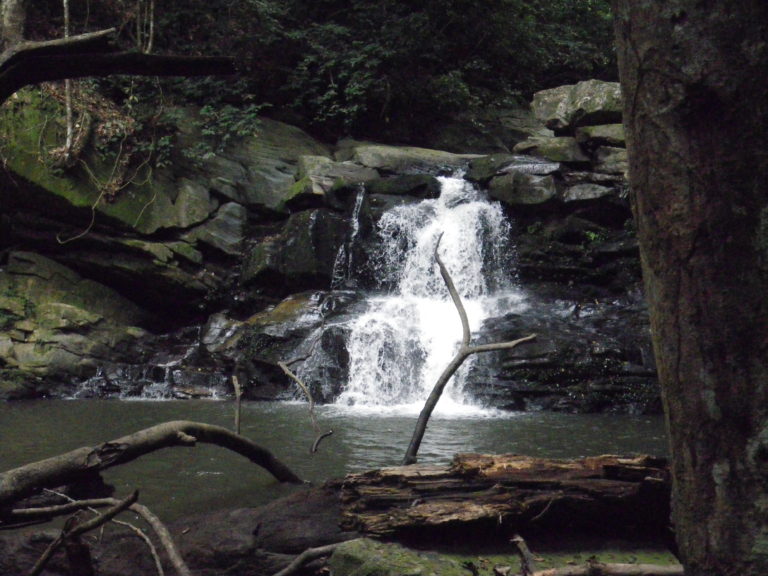
The next exploration is planned in the La Macarena range, which is unusual in running perpendicular to Colombia’s three cordilleras and in lying in the flat Llanos region. As we approach, we spot a waterfall in the distance: the place must be teeming with begonias… although we have no GPS point for this area! But how do we get there from Maracaibo, the last village before the mountains, which are still far away? A young motorcyclist offers to guide us across fenced pastures; he opens the gates and closes them after our 4×4 has passed. The waterfall is superb (photo 3) but we don’t find a single begonia! Not one along the river flowing from the falls either! And yet all the conditions (heat, humidity, relief) are there. Where are they? Jean-Louis finally finds one, the very common Begonia fischeri, in a ditch in the next meadow! What a pity! We console ourselves on the way back with a cold beer in the motorcyclist’s friendly village.
First discoveries
The next day a GPS point is supposed to lead us to Begonia macra, which apparently grows on rocks in open ground; we find the place (fenced off!), with lots of rocks and lots of houses nearby! Not a single begonia!
We then switch habitats completely, to the Espeletia páramo of Sumapaz on the western slope of the same cordillera, and the next GPS point takes us near a farm, on the edge of forest fragments covering the summits. We are at 3,100 m. And there, after climbing over some barbed wire (a constant in Colombia, where there are many cattle pastures), a surprise: we discover Begonia ferruginea (photos 4, 5, 6, 7) in full flower!
Magnificent, splendid! This extraordinary scrambling species grows in the thickets at the forest edge, where it can reach 3 or 4 m in height; each unisexual inflorescence carries about ten flowers of the most beautiful red, a colour also found on the stems and the undersides of the young leaves; the fruits are ripe. It is accompanied by the smaller but equally interesting Begonia urticae (from the same section, Casparaya), which we had already seen in Ecuador. Here, though, it grows in much darker, less accessible thickets. These specimens have pink flowers, whereas they are usually red. A good day…
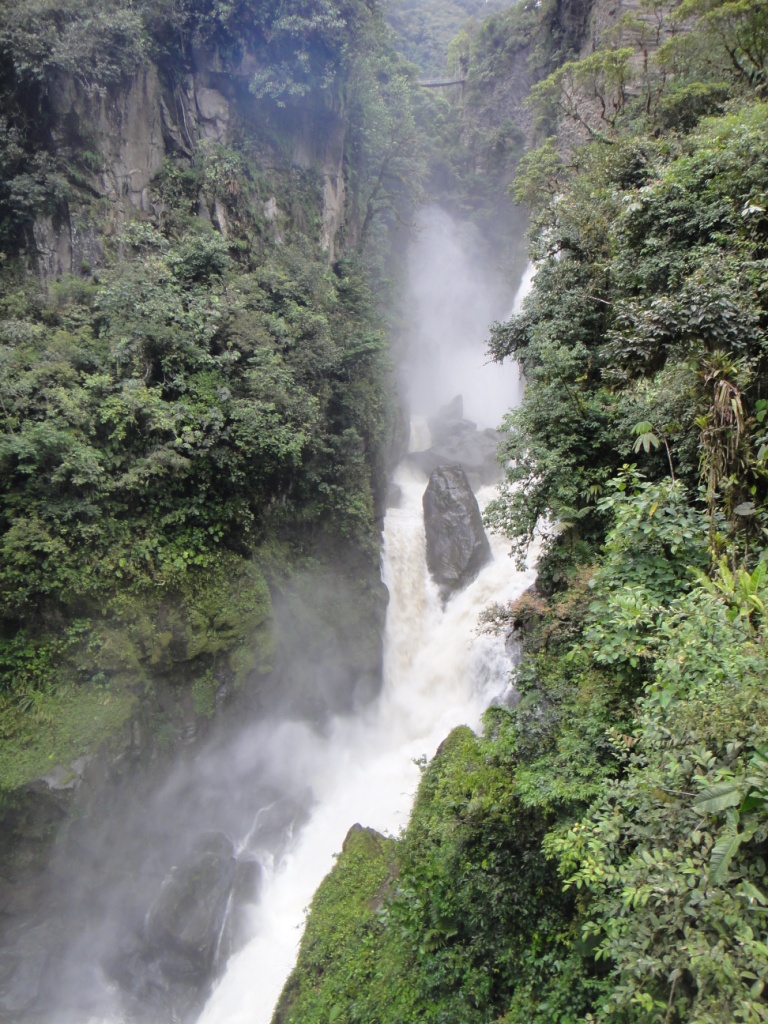
It is 30 January and we skirt round the west of Bogotá to botanise near the Tequendama Falls (photo 8), a magnificent waterfall on a river that is sadly completely polluted, the water and banks covered with a white foam of dubious origin… (tanneries?) The road winds high above the river, and fragments of forest remain on the slopes of the cordillera to the left of the road. In this area we discover our first species of section Gobenia, identified by Mark Tebbitt as Begonia sodiroi (photo 9) ; this creeping plant climbs over shrubs up to a height of 2 m.
On 31 January we climb towards the Tablazo páramo and find Begonia sodiroi again in many places, at an altitude of 2,500 m: it climbs up trees and fence posts. Unfortunately, only one barely formed inflorescence is visible (photos 10, 11).
We search in vain for Begonia cornuta with a waypoint that leads nowhere, and as the one for Begonia dugandiana is much too far away, we give up. These two plants will therefore remain unknown to us…
We now leave the Eastern Cordillera, cross the very dried-up Río Magdalena and explore the eastern slope of the Central Cordillera, approaching the active volcano Nevado del Ruiz, which made headlines in 1985 when its deadly mudflows (lahars) claimed many victims. For now it is content with a spectacular plume of smoke with a “scent” of sulphur – harmless… from a distance! The day of 1 February ends with the discovery of another species, Begonia magdalenae, which I first take for Begonia consobrina, so similar is the leaf (photo 12). We reach the Termales del Ruiz hotel at 4,000 m! Despite the nearby hot spring, it is cold!
We leave the hotel early the next morning to try to get closer to the volcano. After 1 km of track, we discover the second wonder of this trip: Begonia umbellata (photo 13) another red-flowered begonia of section Casparaya, in full flower. We are at 3,500 m! It is a herbaceous plant about a metre tall, with very hairy leaves and bisexual inflorescences, but the fruits have not yet formed. Begonia urticae is also present at the same altitude.
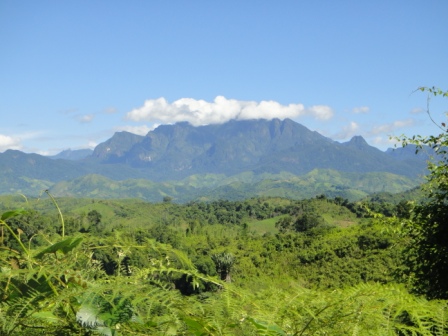
A track takes us to the foot of the volcano, to an Espeletia páramo (photo 14) where the end-of-the-world landscape is extraordinary (photo 15). In the evening we reach the Río Blanco bird reserve, where we will spend two days.
The Río Blanco reserve in the Central Cordillera
Río Blanco is first and foremost a bird reserve, where many amateurs and scientists come to stay. There we can see several species of the genus Grallaria, cousins of the Jocotoco antpitta (Grallaria ridgelyi) we had seen at Tapichalaca in Ecuador, the Crested Quetzal (Pharomachrus antisianus), the Crimson-mantled Woodpecker (Colaptes rivolii) and the Northern Crested Caracara (Caracara cheriway). As the reserve is entirely covered by forest, we are hoping to find… begonias! We are at an altitude of about 2,000 m.
We set off to look for them the next morning and soon discover Begonia maurandiae (photos 16, 17, 18). This terrestrial plant is a climber, and it is everywhere! On the banks and rocks it carpets, on the trees it climbs to 2 or 3 metres; there are many colonies, each with one or more exuberant plants. The leaves are almost symmetrical, often cordate, rarely peltate, with a ciliate, more or less toothed margin. Unfortunately there are very few flowers: we will see only one inflorescence in the whole reserve, hanging from a branch 2.50 m above the ground! An important character for identifying the species: the tepals are toothed.
Throughout the reserve, this begonia is accompanied by Begonia urticae – here with red flowers – and a few plants of Begonia magdalenae.
Ucumarí Park
After two days at Río Blanco, we head west and then north via Manizales and Pereira. We then take the track to Otún Quimbaya. We have lost some altitude and it is warmer than at Río Blanco.
The track winds along a river bordered on the left by a high, damp bank, sometimes rocky, covered with vegetation. This is where we find Begonia holtonis (photos 19, 20). I grew this plant for a long time, and seeing it here in its natural habitat is impressive: it clings to banks and shrubs and reaches a height of 4 or 5 metres! Nothing like growing it in a pot! What is more, it is in full flower and last season’s capsules are still there! A very fine colony. We will come across many colonies in this area. We also find Begonia magdalenae again, though much less often.
In the evening we reach the very well-organised Otún Quimbaya lodge and set off along the track to scout the area, in a well-preserved forest. But a big storm forces us to turn back without any new discoveries.
We leave early the next morning on the track towards Ucumarí Park. We leave the 4×4 after half an hour and continue on foot along the mule path. At the forest edge we find Begonia magdalenae again, Begonia urticae (some plants with white flowers) and a great many colonies of Begonia holtonis, as exuberant as ever. The feeling of being at the end of the world is heightened by the many riders we pass (photo 21) taking their cheeses to town to sell. We thought we would reach the waypoint for Begonia maurandiae, but when it is time to turn back, the GPS shows it is still 2.5 km away as the crow flies! It is too late to go further, especially as the rain is returning.
In the evening at the lodge we are treated to a concert by Golden-plumed Parakeets (Leptosittaca branickii), and the next morning we are woken by Red Howler Monkeys (Alouatta seniculus) calling in the distance…
Towards Antioquia province, further north
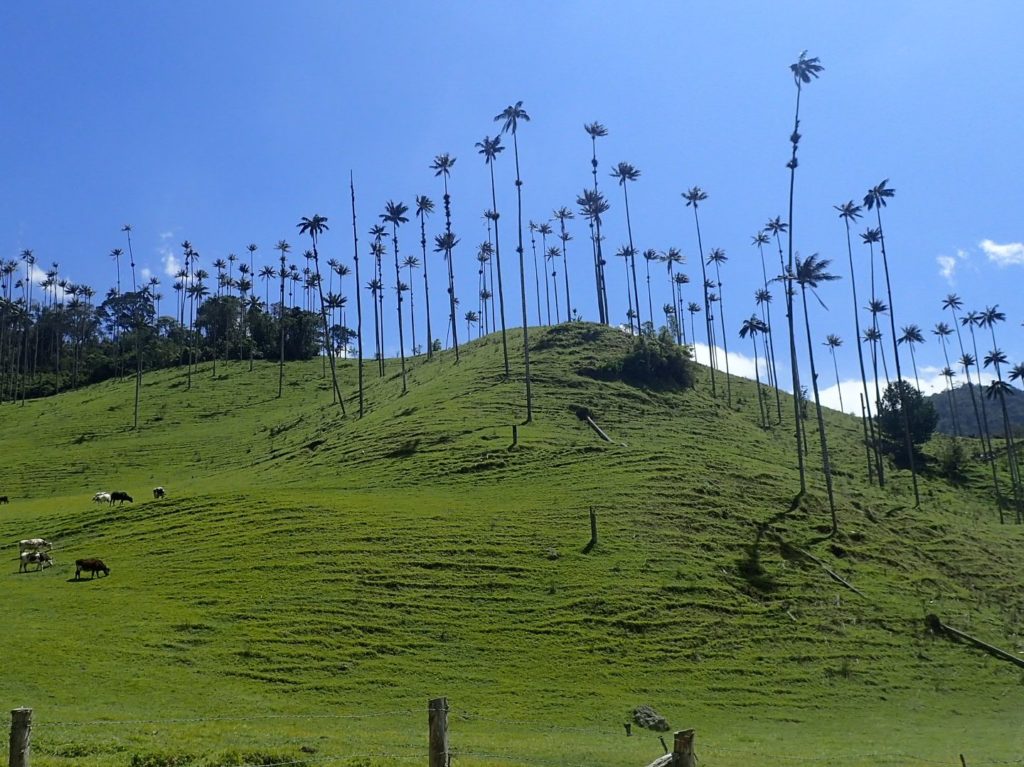
We head north again towards Antioquia province and stop in the tourist town of Salento. A change of scene! Lots going on “in town”: on the Plaza, many restaurants, each noisier than the last, and Willys (photo 22), old jeeps used to drive tourists around; in the streets, many passers-by and musicians… Tourists, mostly Colombian, set off for walks in the Cocora valley: the area was deforested long ago, and only the wax palms (Ceroxylon quindiuense) were kept (photo 23) which gives the place an artificial but striking look. In the forest fragments along the river, not a single begonia – just a Fuchsia (photo 24) with extraordinarily coloured flowers, said to be a rarity!
The next day we lose more altitude and arrive in a very hot, very dry area. On the track to our next stop, Jardín, we find Begonia holtonis and Begonia urticae again. We meet an extraordinary bird, the Andean Cock-of-the-rock (Rupicola peruvianus), with red, black and white plumage: the males are at their lek, putting on a concert of strange calls to attract the females, who have not deigned to come closer.
The next day’s exploration takes us to an interesting site where a farm (the Hacienda Agualinda) is run by a friendly architect, who lends us one of his workers to explore a little-known area of forest. After crossing the river on a very impressive (and very swaying…) suspension bridge (photo 25), we reach the forest and discover a species we do not know; Mark Tebbitt thinks it is a large-leaved form of Begonia foliosa (photo 26); the plant, about fifty centimetres tall, grows on a shady bank, and its white flowers do indeed recall those of B. foliosa. We will only see it at this one site.
Around Urrao
We head for the northernmost point of our stay in Colombia. On a roadside bank, a begonia! It is Begonia sericoneura (photo 27) , dormant and just starting to grow again. No flowers, but many fruits. This species is found mainly in Central America, and here we are at the southern limit of its range.
We arrive in Urrao, our overnight stop, at the Las Araucarias lodge. We immediately head east towards a GPS point for Begonia maurandiae. After a difficult crossing of the stream, we reach the edge of a summit forest, 300 m from the waypoint. But without a machete, it is impossible to get there! We find Begonia foliosa a little further on.
We try another site the next day and discover a begonia unknown to us. This plant (about ten plants over 500 m in a mountainous, forested area), like Begonia sericoneura, is just starting to regrow: young upright stems are shooting from older, woody ones, with a few inflorescences just beginning to form on two plants (photos 28, 29). Mark Tebbitt thinks it is Begonia fagopyroides, but without well-formed flowers we cannot tell for sure. It is from here that we could have reached the Las Orquídeas reserve, 5 hours by mule and 7 hours on foot…
We leave the region by a track that takes us to a very fine colony of Begonia sodiroi. Many plants near a waterfall, and extraordinary inflorescences, quite unusual for the genus Begonia, on plants that have settled on the parapet of a bridge (photos 30, 31) ! We are at about 2,500 m, and it is at these altitudes that we found most of the begonias of section Gobenia.
As we leave the region, we have the chance to visit a small traditional brown-sugar (panela) workshop. We are warmly welcomed by the people who work here, extracting cane juice and making blocks of raw sugar. They give us two…
Last discoveries around Medellín
We reach our last lodge, north of Medellín, in the Chestnut-capped Piha reserve which, like Río Blanco, is a bird reserve. The access track is very dusty and the roadside vegetation is… white. We will find only one species in the reserve itself, in the “cloud forest” at around 2,500 m: a few plants of Begonia buddleiifolia beside a stream. But after the night’s rain, the roadside vegetation has been washed… and we can see the plants much better; that is how we find an interesting species that had gone completely unnoticed when we arrived the day before. Yet another begonia whose leaves look like those of Begonia consobrina! The difference lies mainly in its much larger flowers, especially the males, whose stamens are very well developed – hence its name, Begonia extensa, a plant identified by Mark Tebbitt (photos 32, 33).
Acknowledgements
I would like to thank the American Begonia Society for its financial support, once again, for this trip, as well as the private donors from the ABS Branches and Antoon Hoffnagels from the Netherlands. This trip could not have taken place without their generous help.
Finally, thanks to Mark Tebbitt, who kindly identified the species we found from the photos I sent him – no easy task from photos.