29 May – 30 June 2017
by Jacky Duruisseau
Photos: Colette Bridon and Jacky Duruisseau
After two expeditions in 2003 and 2010, here we are, off on a third adventure in Gabon. Did you say “adventure”? Yes! As you will read in these lines, that is exactly what it was…
There are just the two of us, Colette and me. We chose June because it is the dry season, the only time I can drive a 4×4 without too many rain-related difficulties and use the Gabonese dirt tracks (and even then, it is not a given!).
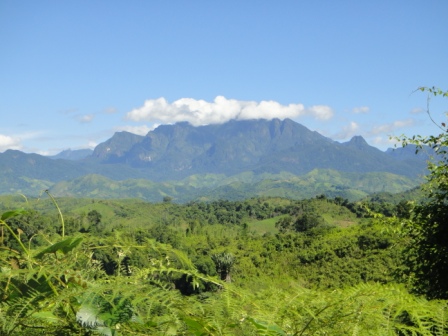
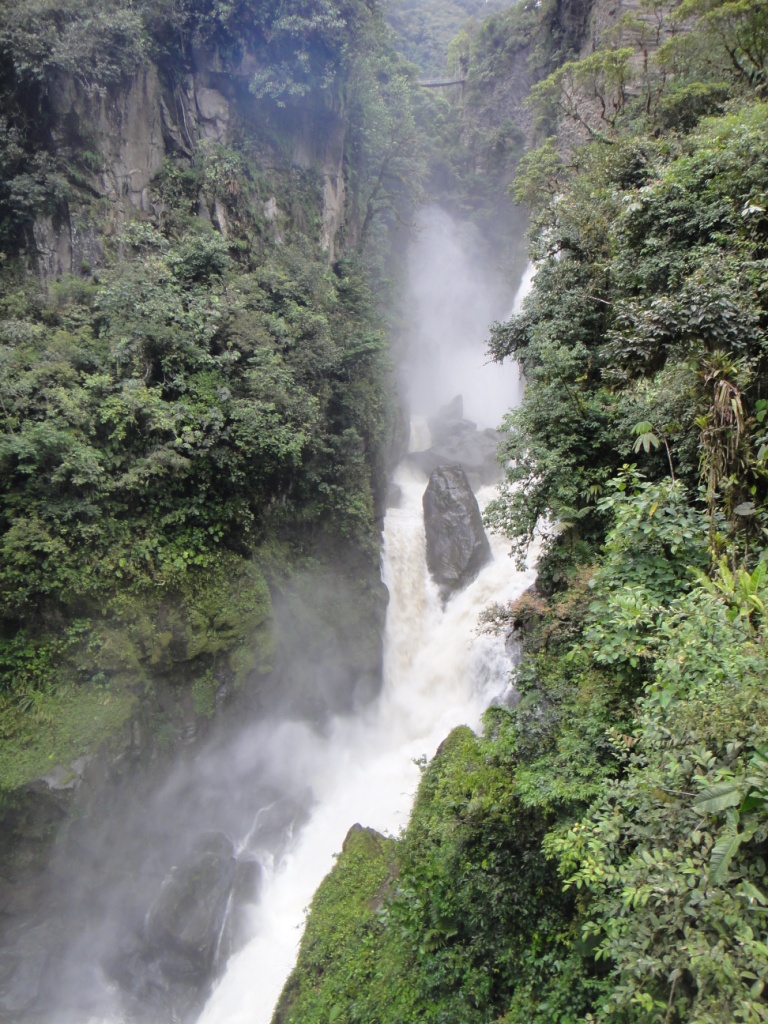
Gabon is a small country in equatorial Africa, whose forest is the most beautiful of all those we have visited in Africa (photo 1), Madagascar and South America. The region is extremely rich in plants of the genus Begonia and more particularly yellow-flowered ones… of sections Loasibegonia and Scutobegonia…
Marc Sosef, a Dutch specialist in African begonias, explains in his thesis “Refuge Begonias” that the mountains of equatorial Africa (in Gabon, among others, the Crystal Mountains, the Chaillu Massif and the Doudou Mountains) served as refuges for the Begonia of the sections mentioned above during the colder, drier glacial periods; in the Pleistocene, the forests and these plants survived on these mountains without being able to spread beyond them (hence the high level of endemism and the priority these begonias give to vegetative propagation over sexual reproduction – the best proof being that they are not self-fertile and that we find few fruits on these plants).
After long and laborious administrative procedures (several months!), I obtained permission from the Gabonese authorities (ANPN, the National Parks Agency, and its scientific unit) to enter and carry out research in these parks and their buffer zones.
This time we plan to go via São Tomé on the way out and back, which means transiting through Lisbon. Take-off from Nantes on 29 May.
São Tomé (31 May to 2 June, then 26 to 29 June):
This small island (about 900 km²) of the state of São Tomé and Príncipe, independent since 1975, is an old volcano rising to 2,024 metres, whose entire mountainous area is covered by dense rainforest. The summits are often in the clouds.
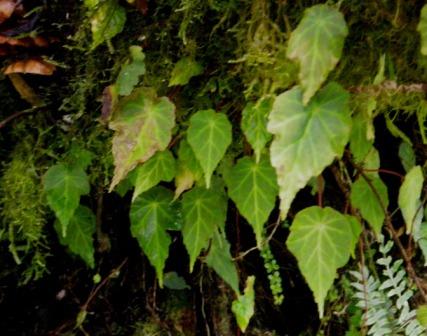
Why stop in São Tomé? Because there are begonias there! No yellow-flowered begonias, as the island is younger than the mainland where Gabon lies, but a high level of endemism due to isolation: São Tomé lies in the Atlantic, opposite Gabon, just below the Equator and about 350 km from Gabon. It does have some very interesting begonias, however, in particular the emblematic endemic Begonia baccata (photos 2, 3, 4, 5).
We come across it very often during our first hike from Bom Sucesso to Bombaim, which is not really a stroll: 18 km of mountainous terrain at 30°C in the shade! B. baccata is everywhere, from sea level up to 1,500 m. It is a spectacular plant, usually upright – it can then reach 2 m in height – sometimes hanging on steep banks or cliffs, and even epiphytic on trunks; it is very often in flower at this time of year; we notice many fruits, unripe at the end of May but ripe when we return at the end of June, when they are a lovely bright red; we see many seedlings on the banks and also on the ruined walls of roças forgotten in the forest – the remains of the cocoa plantations, abandoned since independence.
Antonio, our guide for the day, claims that B. baccata is the largest begonia… but he does not know B. parviflora from Ecuador…
On the same hike we also find B. crateris (photo 6) near an old crater. This begonia looks like B. baccata, but almost the whole plant is covered in an indumentum (a covering of hairs) that B. baccata does not have, and its leaves are peltate and thicker; it seems less developed (perhaps we did not see a mature plant?); the specimens we find are not in flower. It is also much less common than B. baccata and is confined to altitudes between 900 and 1,500 m.
During our second stay in São Tomé, on the way back from Gabon, we follow the west coast of the island. There, on lava cliffs, we find B. baccata accompanied by a small annual plant, B. annobonensis (photos 7, 8) (named after the island of Annobón, near São Tomé), just starting to flower; it is characterised by a circular tuft of hairs on the underside of the leaves, where the petiole is attached.
The main aim in coming to São Tomé was to find Begonia thomeana, a terrestrial climbing plant that is not strictly endemic, as it is also found in the Chaillu Massif in Gabon. Adilson, our taxi driver, takes us to Bombaim, from where we set off with Francisco, a São Tomé guide who knows the forest well. I have a GPS record for B. thomeana 2 km south-west of Bombaim – a point impossible to reach, so complicated is the access! We slog through the mud for 4 hours along endless paths that never bring us any closer to the point! Once again we find that when a GPS point is more than 1 km away, it is very hard to reach! A forester cheers us up with a tasting of the palm wine he has just collected… Francisco, meanwhile, has stocked up for his lunch… with beetle larvae, collected from a rotten stump!
In this area we find B. ampla (photo 9) , not endemic and present throughout equatorial Africa. Only one plant in flower, but many young epiphytic plants on the trunks.
We could also have found on the island: B. molleri, B. loranthoides subsp. loranthoides and B. subalpestris, all three from section Tetraphila.
We leave the friendly people of São Tomé after these two short but intense stays… The island is no paradise, but we have fond memories of the good humour of its people (photo 10) especially in the fishing villages of the west coast, when the pirogues come back from fishing (photo 11).
Crystal Mountains region, Gabon (4 to 9 June):
Libreville: a visit to the ANPN, where we meet Flore Koumba Pambo of the Scientific Unit, who handled my application and thanks to whom I was able to obtain a research permit. Then we pick up the 4×4. Off to the Crystal Mountains.
June is the start of the dry season and the sky is often grey in the mornings. The road out of Libreville is… catastrophic for 60 km, and we can easily imagine the ordeal it must be in the rainy season…
At Kougouleu, about 70 km from Libreville, we head north towards Assok. We pass the villages of Mela, Nkan and Song and start exploring the streams coming down from the mountains. There we find B. hirsutula, B. clypeifolia very common (photo 12), B. macrocarpa and B. sciaphila (which looks very like B. auriculata, but the latter has three-winged fruits, whereas those of B. sciaphila have 4 wings).
We search in vain for B. aggeloptera , described by Marc Sosef as very common in the forest near Nkan. In the evening we are caught in a heavy downpour. Dinner is partly eaten in the back of the 4×4, before we bivouac. In the bush, with no electricity (apart from our head torches), we live by the sun: bed around 7 pm and up around 7 am…
Early the next morning we set off to explore the rivers north of Nkan. We meet many begonias: B. clypeifolia still in great numbers, B. auriculata, two forms of B. lacunosa : one magnificent, dark, with a light green midrib (photo 13) and one with a very dark, almost black, bullate blade (photo 14).
I then discover what I believe is B. peperomioides, a rare species I do not know; unfortunately, unlike B. peperomioides, the plant I found has peltate leaves, and Marc Sosef thinks it is more likely a form of B. clypeifolia (photo 15). Disappointing!
Epiphytes are also present: B. elaeagnifolia and B. eminii, in full light, in flower and with red fruits (photo 16). At this very rich site we also notice a pretty Impatiens and, in great numbers, Costus englerianus with white flowers.
We leave the buffer zone of the Crystal Mountains park and head for Kinguélé, in the park itself. Another bivouac, and a fierce attack by “fouroux” before nightfall. These tiny, formidable blood-sucking insects (blackflies) get through the mesh of the mosquito nets we put over two open windows of the 4×4 to keep it ventilated at night. So the little beasts got into the vehicle… Bites guaranteed, and plenty of them!
Kinguélé: formalities with the gendarmes, who check my permits, then a look at our lodgings with our guide, who says his name is JT (sic!). In every park we must be accompanied by an ANPN guide: he makes sure we follow the rules and “watches over” our safety… A green snake welcomes us in the hut. JT, unable to get it out, wants to kill it! We object and politely ask the snake to leave, which it does…
We spend the afternoon in the forest below the Kinguélé power station, on the left bank of the Mbei river, a site very rich in begonias. There we find, from section Scutobegonia : B. hirsutula, B. scutulum , endemic to Gabon, which looks like the previous one but has larger, peltate leaves, and B. erectotricha (photo 17). Then, from section Filicibegonia, we find B. elatostemmoides and B. auriculata.
We leave early the next morning, 2 km north of Kinguélé, to explore the gorges of the Mbivame river, a tributary of the Mbei. Another very rich area: B. lacunosa is very, very common, especially the dark form with a slightly bullate blade, but very few specimens are in flower and there are a few unripe fruits. We find B. clypeifolia, B. scutulum, one flowering plant of B. erectotricha, and one plant (just one) of B. heterochroma (photo 18). B. sciaphila, B. auricula and B. elatostemmoides are also present. A gesneriad with black foliage and white flowers spreads over the ground in large numbers, and a magnificent little Impatiens (photo 19) carpets the rocks at this site.
In the afternoon we take the Kinguélé – Tchimbélé road to explore the small rivers coming down from the Crystal Mountains, and to try to find the hollow beside the track where we had seen B. vittariifolia, B. susaniae and B. letouzeyi. As the track has been widened, it looks as though this site has been destroyed. On the way back, we stop in the village of Makabane, where the chief (yes, there are women village chiefs in Gabon!) shows us her garden. To finish, we go up a small river full of rocks and very rich in B. letouzeyi , of which two forms appear: one with a densely hairy upper blade (photo 20), the other glabrous (photo 21) ; we also find B. susaniae (the very bullate type form, and a form with a non-bullate, dark, suborbicular blade (photo 22). A day rich in discoveries. We have well and truly earned a beer (the last ones!)
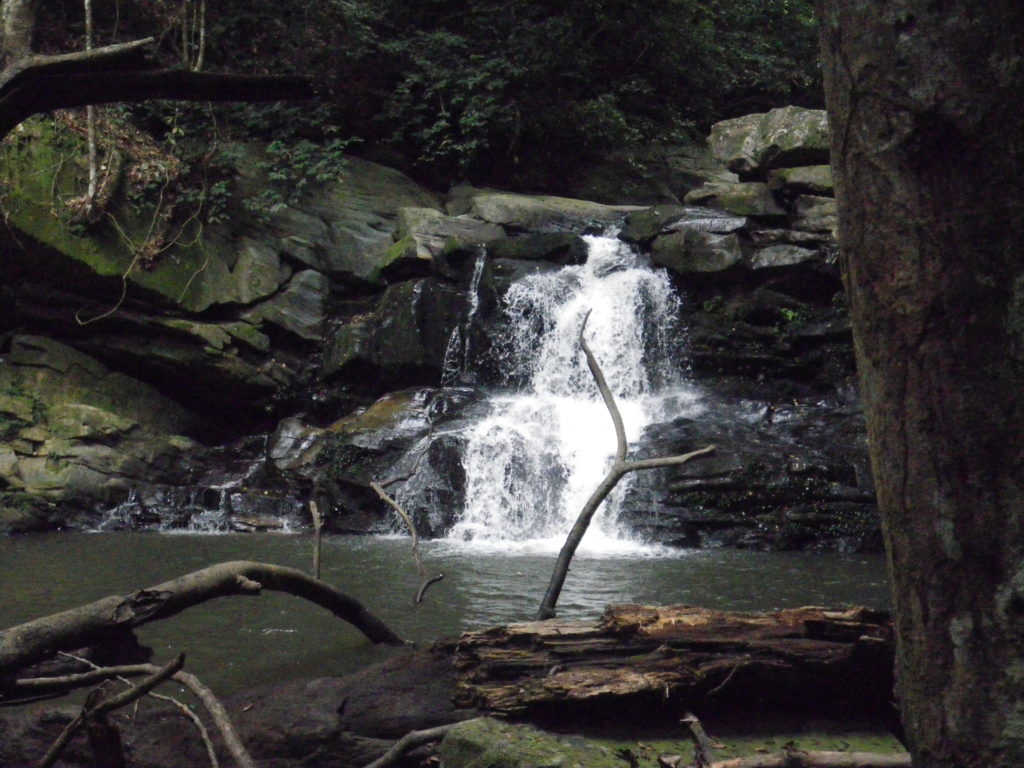
Last day in the Crystal Mountains: plenty of B. lacunosa on the litter of the “SEEG trail” (Société d’Énergie et d’Eau du Gabon) just north of Kinguélé, in its dark form and its green form (photo 23). We then visit the waterfall known as the “Kinguélé falls”, but it is practically dry in early June. Few begonias at this site; we do note, however, the rare B. erectotricha, then B. sciaphila in fruit. One last river (photo 24) shows us B. scutulum in flower, B. hirsutula, B. letouzeyi, B. lacunosa (that one again!) and B. auriculata.
Back to Libreville along the SEEG track, then hello again to the traffic jams and the potholed (national!) road before reaching the capital to restock.
Around Ndjolé, the Lopé reserve and an attempt to reach the Chaillu Massif (10 to 14 June):
We leave Libreville again on 10 June, early, to avoid the traffic jams in the capital’s suburbs. The road is paved and in good condition from Kougouleu. We head for Ndjolé, in a mountainous area rich in begonias, where I hope to find B. wilksii. A stop at the Auberge Saint-Jean just before setting off to explore the rivers crossed by the Ndjolé–Mitzic road to the east. Unfortunately, the directions given by Marc Sosef are no longer valid: they started from the old track that ran along the Ogooué river for about twenty kilometres, which no longer exists and has been replaced by a paved road further north. What is more, the GPS positions are given to the minute (in fact, according to JJFE de Wilde, a Dutch botanist and leading specialist in African begonias, these positions were recorded after the expedition, on a map divided into “1-minute” squares, because in the 1980s GPS did not exist!). And one minute is 1,800 m on the ground! Impossible to find B. wilksii ! All we can do is go up every river that crosses the road before flowing into the Ogooué! As you will have gathered – and it is always the same problem – a begonia-hunting trip needs far more than a month! The two rivers we explore that evening give no results!
The next morning we explore two more rivers, one of which, at km 20, offers two interesting species growing on the steep banks: an uncommon form of B. scutifolia, with a falcate, slightly succulent blade and leaves held almost horizontally; the second is another form of B. lacunosa (photos 25, 26, 27) (that one again!), with vertical leaves pressed against the bank, an elliptic, very asymmetrical blade and white flowers. I notice that B. scutifolia occupies the bottom of the banks, while B. lacunosa grows mostly near the top. A second river, the Beloubelou at km 43, gives us nothing of interest.
We set off for the Lopé reserve. From the paved road we have to cover 80 km of a very rocky track, which takes… 3 hours 30! The Lopé reserve is a vast savannah of about 5,000 km², crossed by the Ogooué (photo 28), dotted with mountain forests and gallery forests. In the evening we meet our friendly Gabonese guide, Ghislain. We are to meet at 7 am for the park entry formalities and a drive through the reserve, hoping to see animals – buffalo, elephants, gorillas, etc. – and, who knows, perhaps some begonias.
Driving around the reserve is no picnic: the track is not maintained and is often hidden by tall grass! We will see few animals (a female chimpanzee with her baby, a few small monkeys and many elephant tracks).
We look for begonias in the forest: a mountain stream raises our hopes, but nothing! No vegetation at all on the rocks of this stream (photo 29) , whereas they are usually real hanging gardens! Surprising! Is it due to the type of rock? People at a research station point us to a possible spot, and indeed, in the bed of a very hard-to-reach stream, we find the begonia of the day B. mildbraedii (photo 30) with flowers and fruit (photo 31).
We set off again the next day: Ndjolé, Bifoun, Lambaréné, Mouila, then we turn east towards Yeno, and so towards the Chaillu Massif, known to be very rich in begonias. Unfortunately, 35 km from Mouila, a Caterpillar has broken a bridge! We turn back and detour via Bilingui. We finally reach Yeno. We are 26 km from Mimongo, which a tree fallen across the track had prevented us from reaching in 2010.
We will not get to Mimongo this time either: 2 km from Yeno we come up against an enormous quagmire, 100 m long with ruts 60 cm deep! Impassable, even with the 4×4!
Heartbreaking! We turn back and bivouac in the vehicle. We head south early the next morning without breakfast, because the fouroux are attacking!
Moukalaba-Doudou National Park, Doussala. We will not get to Mount Mougoubi! (16 to 20 June)
After a stop in Fougamou, we head for Tchibanga in the south-west. The road, recently resurfaced, is good. Unfortunately the work has not been finished, and the last 35 km are on an appalling track. At the last checkpoint (we went through about twenty on this trip, at the entrance and exit of every town), the gendarmes coming off duty ask us to take them to Tchibanga… On arrival they guide us to the ANPN office that manages Moukalaba-Doudou National Park, where I present my permits. There we meet our guide Peter, from the organisation PROGRAM, which protects the park’s great apes and works with the ANPN in Tchibanga. The people of Doussala are involved in this association and contribute trackers, porters, a cook, and a pirogue with its boatman to cross the Moukalaba – the bridge over the river has been broken for… more than 10 years! As there is no vehicle available in Tchibanga, we will have to take Peter, a tracker and all the supplies to Doussala in our 4×4!
More than 3 hours to cover the 70 km, with a particularly difficult track for the last 10 km! We pass a herd of Defassa waterbuck (photo 32) in the savannah that stretches from Tchibanga to Doussala and the Doudou Mountains. We settle in at Doussala in the Case Madre (photo 33), the former house of the forester who ran the logging operation in the Doudou Mountains until 2000, which was shut down when the park was created. The Doudou Mountains are the park’s hotspot, home to many endemic plants, including begonias. When the bridge over the Moukalaba still existed, you could drive there. Now you have to cross the river by pirogue and walk 15 km to reach the mountains!
For now, before leaving for the Doudou Mountains, we have planned 2 days in Doussala to try to see the gorillas, which here are being “habituated” to the presence of humans (and of tourists – few, it must be said…). Peter takes us, with trackers, into the forest that starts just behind the Case Madre. In case of danger, the rule is to stay between the tracker (in front) and the guide (at the back), whatever happens; if elephants charge, you must run and “hide” behind a tree… We will not see a single gorilla! But we are charged by some really unfriendly elephants! I lived in Gabon for 5 years without ever seeing an elephant, but here I realise how dangerous these animals can be, especially when there are young in the herd. And in the forest you hear them without really seeing them. When you can no longer hear them, yet they are still nearby – danger! Fortunately both charges were short: the big “bearer” (a male that accompanies the herd) stopped after a 15 m charge (just as well, as we were in thickets without the big trees meant to protect us). We will long remember the trumpeting before the charge – impressive! The second attacker was a youngster who stopped very quickly. When it charged, we expected to see a gorilla burst out, since we had found a superb… dropping just before…
We do find a few begonias, though: a superb form of B. lacunosa (photo 35), B. mildbraedii and B. elatostemmoides (photo 36), all grouped in the same spot, between two laterite banks.
Comfort at the Case Madre, where Mamina, our cook, works wonders that we enjoy at dinner (photo 34).
Then something else happens: the fouroux, very numerous here, attack early in the morning and late in the day, every day, especially when the weather is grey. There are hundreds of them! Usually the bite causes intense but short-lived itching. Colette, however, has a severe allergic reaction, with inflamed patches on her legs, made worse by her trousers rubbing on the skin! The nearest doctor is in Tchibanga, there is no phone signal, and we probably have 25 km to cover to reach Mount Mougoubi, our goal in the Doudou Mountains (the GPS shows the summit 18 km away… as the crow flies…). We give up. It was too risky to embark on this adventure! And Mount Mougoubi is where this one grows: B. dewildei…Regrets!
This is the end of the trip…
So we are ahead of schedule, as the Mount Mougoubi expedition was meant to take 4 days. We decide to go back via Ndjolé and revisit – this time going upstream – the river at km 20 that we explored on our first visit; a lovely begonia river where I find the same plants B. scutifolia (photo 37) and B. lacunosa, but also, upstream, elephant tracks with very fresh dung! I am alone and without a tracker – caution, and back I go… At km 19, another stream, hard to reach and very shady, lets me find again B. scutifolia and an unidentified species (photo 38) : dark leaves, not peltate, red underneath, very asymmetrical, with a crenate margin and a typical fruit (photo 39) of section Scutobegonia, three-winged but with white hairs at the tips of the wings, an uncommon character in plants of this section: it is not, as Marc Sosef and I thought, B. anisosepala , whose leaves are peltate. A hybrid? A new species?
My memento of this site is the bites of the “magnans”, formidable driver ants that I must have disturbed on the way down to the stream, and which were waiting for me on the way back…(photo 40)
Back to Libreville from Ndjolé (photo 41) and the packing, always a chore…
All in all, a fairly positive result: 18 species found, and 3 we would have liked to find: B. wilksii, B. aggeloptera and B. dewildei…and a species still to be identified or described…
It is unlikely that we will ever return to Gabon: too complicated, too difficult, before and during…!