Ridley 1894
Malaysia
Section Reichenheima
This magnificent begonia, known and grown for a long time, was collected in Malaysia and introduced to the Singapore Botanic Gardens in 1892. Almost wiped out by the destruction of its habitat (it is endemic to Peninsular Malaysia: Terengganu and Johor), it was rediscovered by R. Kiew in 1989. It is considered a threatened plant but, fortunately, is widely grown. Its name comes from the Sanskrit “raja”, meaning “king”.
Appearance
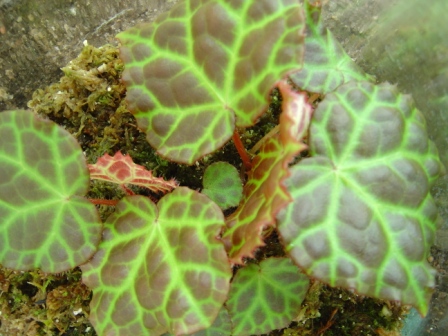
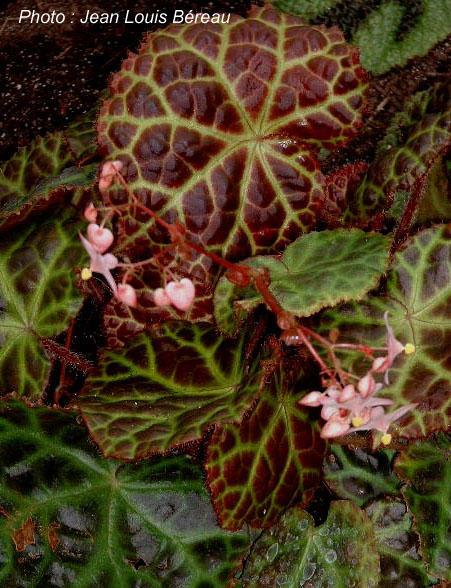
A small, creeping rhizomatous begonia. The blade is bronze-green to purplish brown, more or less puckered, with the veins picked out in light green. It is glabrous, with a finely toothed and ciliate edge, circular and acuminate. The inflorescence is axillary and bisexual. The male flowers are white and pink with 4 tepals. The female flowers are pink with 3 tepals. The fruit has three equal wings.
Culture
A terrarium plant that likes high humidity (as it grows on rocks along streams) but fairly low temperatures, around 20°C. In a large terrarium, old leaves drop and root spontaneously. It is fairly easy to get seed in cultivation.
Propagation
Cuttings root easily in a closed, humid environment, and sowing fresh seed is also simple.
Publications
For those who want to know a little more about this species, here are two articles in English. The first is taken from the Gardeners’ Chronicle of 1894 , which reports on the showing of this species, which won an award from the Royal Horticultural Society. You can view the second by clicking here; it is an article from the American Begonia Society.